
Start with observable activity
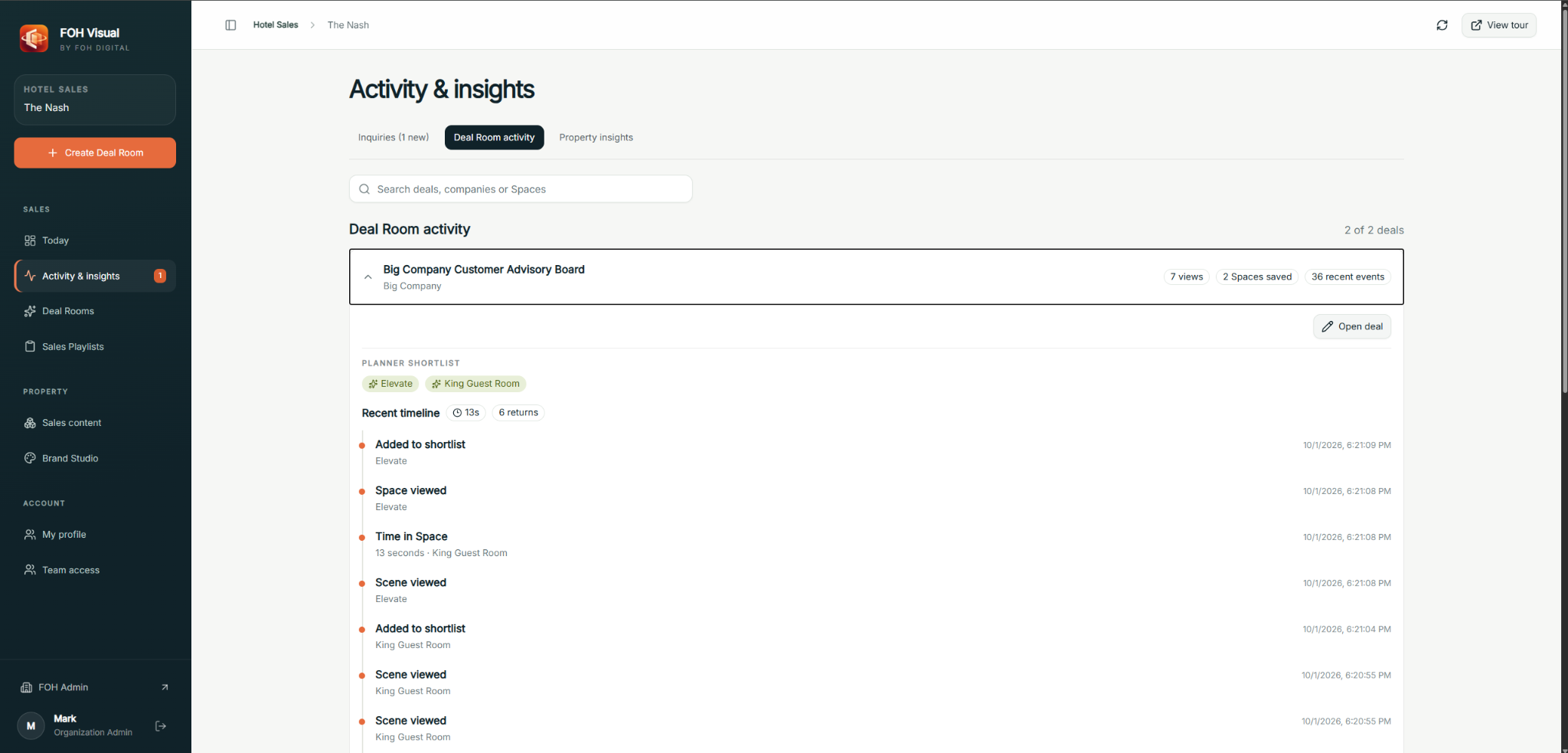
A sales team needs to know more than whether a link was sent. Did someone return? Which spaces did they review? Did the shortlist change? Was there an inquiry?
FOH Visual’s current Reporting layer separates the all-date Inquiries inbox, Deal Room activity and deeper analysis. Reporting can include browser-session visits, public-tour / Sales Playlist / Deal Room context, acquisition, Space and configuration engagement, resource activity, shortlists, inquiries, seller adoption, chronological guest journeys and hotel-reported outcomes. Review the underlying evidence before drawing a conclusion. A browser session is not automatically a uniquely identified person.
Turn a signal into a better question
| Activity | Useful follow-up | What it does not establish |
|---|---|---|
| Return to a ballroom | Would another setup or a closer look at the floorplan help? | Approved event fit or a booking commitment |
| Shortlist change | Has the program or preferred room changed? | A room hold or inventory request |
| Collateral download | Do you have questions about the package or planning details? | Acceptance of pricing or terms |
| Limited recorded activity | Was the link useful, and who else needs the information? | That the opportunity is lost |
Use the activity to prepare your conversation. Avoid making the buyer feel monitored. Lead with a helpful answer or a relevant question, and give them room to correct your interpretation.
Ask the buyer what the activity means
Someone may review a room repeatedly because they like it, because they cannot understand it or because the proposed layout is creating a problem. A long session may include an idle browser. An email preview, shared device or forwarded link can complicate identity.
The salesperson provides the missing context. Record the buyer’s answer and the opportunity stage in the hotel’s commercial workflow. Digital behavior is supporting evidence, not an automated probability of booking.
FOH deliberately shows the underlying activity rather than promising an opaque predictive intent score before enough real outcome data exists to validate one.
Measure adoption and workflow value
Define what counts as a Deal Room sent and a qualified opportunity. Compare response preparation time for similar program complexity. Track how consistently the team uses approved materials.
For buyer activity, use counts before percentages when the sample is small. Record return visits, shortlist changes and questions that lead to useful follow-up.
For commercial outcomes, distinguish pipeline receiving a FOH experience from Open/Won/Lost outcomes and any hotel-reported contract value. Contract value is not paid revenue, and a FOH-touched opportunity is not evidence that FOH caused the sale.
Use the journey, then reconnect it to the sales record
Guest journeys show chronological browser-session activity within one property and report period. Use them to understand what was explored and in what order, then reconnect that evidence to the opportunity record and the buyer conversation. Maintain an opportunity ID in the hotel’s commercial workflow so the property can reconcile FOH activity with its sales-and-catering or CRM records.
FOH has a property-scoped integration foundation for future connections. Live vendor adapters and automated engagement export are not available merely because a mapping plan exists. Confirm the implemented scope before describing a connection as active.
A useful pilot scorecard
| Measure | How to record it |
|---|---|
| Adoption | Deal Rooms sent on qualified opportunities / qualified opportunities in the pilot |
| Preparation time | Observed minutes for comparable buyer responses before and during the pilot |
| Engagement | Recorded returns, space activity, shortlist changes and inquiries |
| Follow-up value | Examples of questions resolved or recommendations revised using the activity |
| Commercial context | Pipeline and closed-won values reconciled with the hotel’s system of record |
Record the conversation the activity helped
Add one useful note to the pilot record: the observed activity, the question sales asked, the buyer’s answer and what changed in the recommendation. For example, a return to a ballroom may prompt a setup question; only the buyer’s answer establishes whether the setup was the concern.
This gives the team evidence of follow-up usefulness. Pair it with the pilot scorecard and keep opportunity outcomes in the commercial record.
Common questions
Does engagement prove that a planner will book?
No. Activity gives the salesperson context. The buyer’s requirements, availability, terms, internal approvals and direct conversation still determine the decision.
Does FOH automatically sync activity to our CRM?
The current product has integration preparation. A live vendor adapter must be implemented and enabled before an automated connection can be offered.
Can we claim FOH caused revenue?
You can report documented opportunities, hotel-reported outcomes and values with a clear measurement window and method. Do not call that paid revenue or revenue caused by FOH without stronger downstream attribution evidence.
About this guide
Prepared by FOH Digital. Working examples are illustrative. Product descriptions reflect the reviewed scope; external sources are linked below.